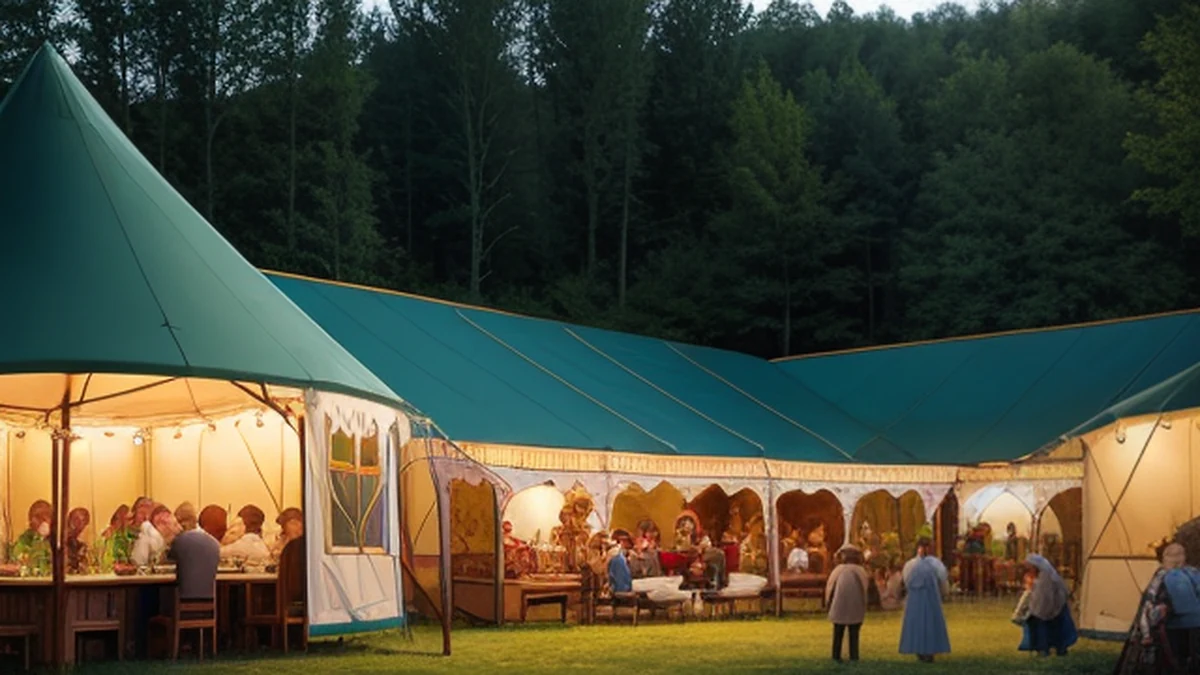
If you ask someone in Brazil what Oktoberfest is, the answer will almost always be the same: a bunch of people in lederhosen drinking beer from giant mugs. That’s not wrong—it’s just incomplete. The festival that Germany takes more seriously than any foreign stereotype has a logic, a history, and a way of working that almost never shows up in Instagram photos.
It’s not in October (for the most part)
First surprise: the original Oktoberfest, the one in Munich, takes place mostly in September. It begins on the Saturday closest to September 15 and ends on the first Sunday in October. The name stuck as “Oktoberfest” due to historical tradition—the first edition, in 1810, was a royal wedding that stretched into October—but Germany quickly realized that September has much better weather for drinking beer outdoors for two weeks straight.
It began as a wedding and became a national identity
The festival was founded in 1810 to celebrate the wedding of Crown Prince Ludwig of Bavaria to Princess Therese von Sachsen-Hildburghausen. Munich residents were invited to the celebrations on a field just outside the city—still known today as Theresienwiese (“Therese’s Meadow”), or affectionately Wiesn by the locals. What began as a one-time wedding celebration became an annual tradition, and the horse race that concluded the original festivities gave way, over time, to the beer tents we know today.
The tents aren’t all the same—and that matters
A common mistake among first-timers: thinking any tent will do. There are about 14 large beer tents, each run by a different Munich brewery (the six authorized by Bavarian law to serve at Oktoberfest: Augustiner, Hacker-Pschorr, Löwenbräu, Paulaner, Spaten, and Hofbräu). Each tent has its own personality: the Hofbräu-Festzelt is famous for attracting tourists and being the noisiest; the Augustiner-Festhalle is preferred by many locals because it serves beer from wooden barrels, not metal tanks. Arriving early is important—on weekends, the tents fill up before noon, and finding a table becomes a challenge.
The beer is stronger than it seems
The beer served at Oktoberfest, called Wiesnbier, has a slightly higher alcohol content than regular German beer (somewhere between 6% and 6.3%, compared to the 5% average of an everyday Helles). Add to that the fact that it’s served in a full-liter mug (the famous Maß), and it’s easy to underestimate how much you’re drinking—which is why hearty food, like Hendl (roast chicken) and Brezn (giant pretzels), is part of the ritual, not just a side dish.
What do Germans themselves think of all this
It’s worth a reality check: many Germans, especially outside Bavaria, view Oktoberfest with a certain detachment—to them, it’s a Bavarian regional tradition that has become a national cliché for the rest of the world, much like how foreigners might think that every Brazilian dances samba all day long. This doesn’t diminish the festival (which boosts Munich’s economy by billions of euros every year and attracts over 6 million visitors); it just helps us understand that “German culture” is far more regional and diverse than the image exported abroad.
One final tidbit: there’s an alcohol-free, crowd-free version called
In recent years, Munich’s Oktoberfest itself has added an area called Oide Wiesn (“the old Wiesn”), with lower prices, a calmer atmosphere, and a focus on historical traditions—vintage carousels, traditional Bavarian music, and less mass tourism. It’s the side of the festival that almost never shows up on social media, but which many locals prefer.
Want to understand German beyond the clichés?
At DeutschBloom, you learn through real dialogues, everyday expressions, and native audio—without boring guided narration, at your own pace.
Learn more about DeutschBloomRelated articles

Stop learning German without understanding Germans
You can know all the grammar and still feel lost in a real conversation. DeutschBloom's podcasts put you inside the culture while training your ear — start now, free to try.